A Detailed History
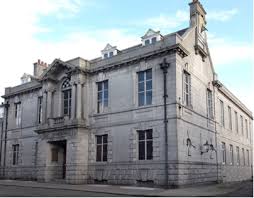
Freemasons’ Hall, formally known as the Masonic Temple, in Crown Street Aberdeen, is not only the pride of the Masonic Fraternity in the city but is considered to be among the finest, if not actually the finest, purpose built building devoted entirely to Freemasonry within the Scottish Constitution.
The Grand Lodge of Scotland currently consists of 985 Lodges, which meet regularly, some 643 of them in Scotland, with the remainder in different countries all over the world.
Freemasons’ Hall, which is of Kemnay Granite, was designed by Brother Harbourne MacLennan an Architect with a local firm (Jenkins and Marr) which is still of great note in the city.
The interior of the building comprises of a magnificent entrance hallway; a Chapter Hall with anterooms and a Crypt below, a Provincial Hall with anteroom, and a small lounge all on the ground floor.
On the first floor there is an office, and a spacious display landing, which leads to an entrance hallway with anterooms, all leading into the main Temple, or Craft Hall. There is a caretaker’s flat on the top floor and in the basement, a boiler room, toilets and storage space.
The building was estimated to have cost £8555 and was completed inclusive of all fees furnishings and outlays for a total sum of about £20,000.
In 2012, a valuation for insurance purposes covering the buildings and contents was estimated to be £8.25 million for replacement. Regrettably many of the carvings and adornments would be impossible to recreate.
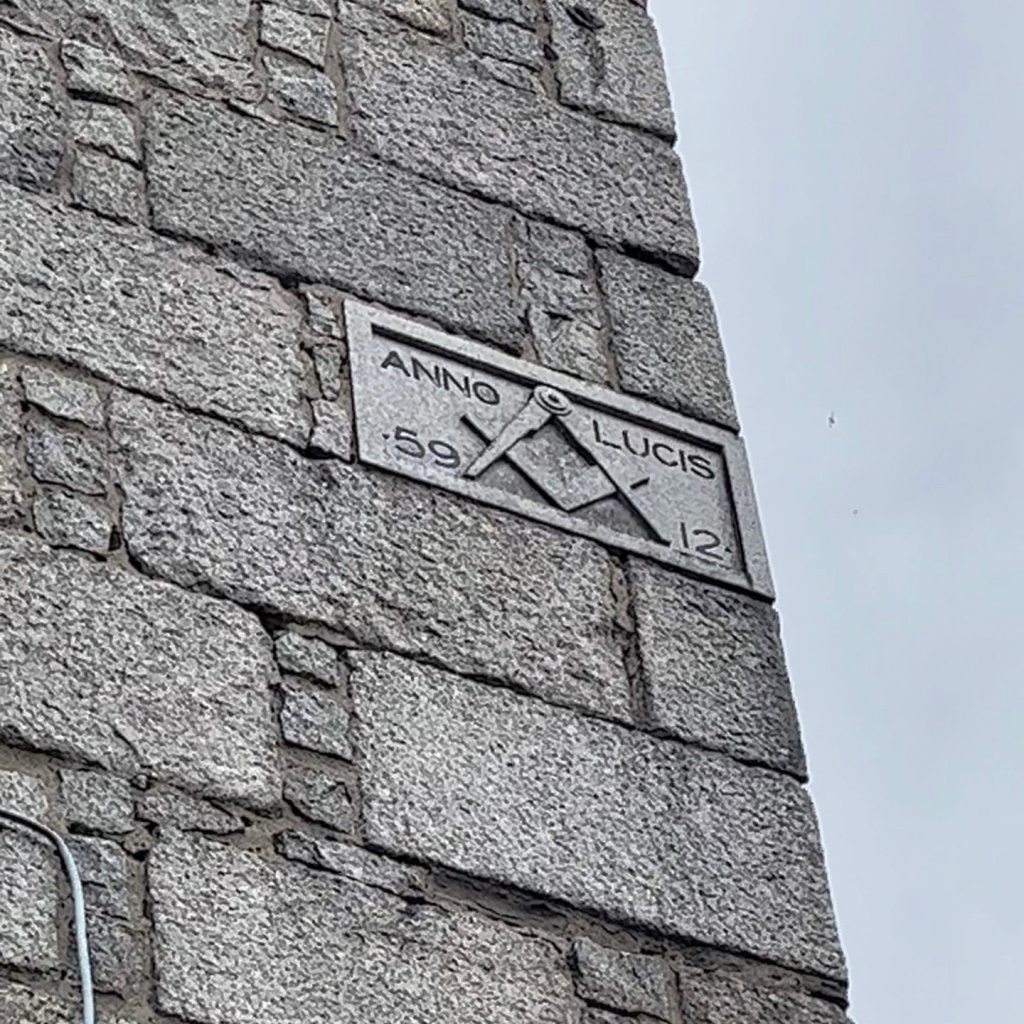
The Foundation Stone, which can be seen at the rear of the building at first floor level, was laid on 7th November 1908 by Brother Alexander Wilson who was the Provincial Grand Master of The Provincial Grand Lodge of Aberdeen City. It is interesting to note that at that time he was also Lord Provost of Aberdeen City.
As the building took shape special adornments were highlighted. These include a handsome frontage on Crown Street, which has a portico with coupled Ionic columns, and a large circle headed window flanked on each side by four large windows and crowned with heavy cornice and blocking courses.
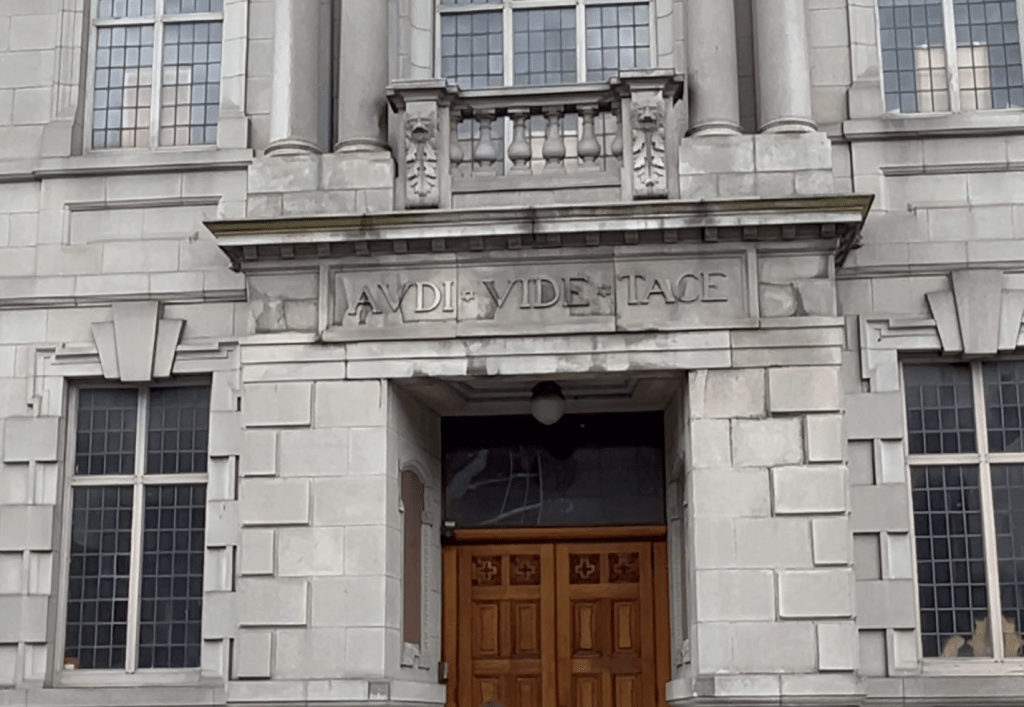
Over the entrance door are the Latin words – ‘AUDI – VIDE – TACE’, which means ‘Hear, See, and be Silent’.
Various Masonic emblems were used as adornments on other parts of the building, while in St John’s Place at the south side of the building the principle feature is a high gable with a chimney head and a Sundial based on the well known and beautiful example at Morden College, which was designed by Sir Christopher Wren.
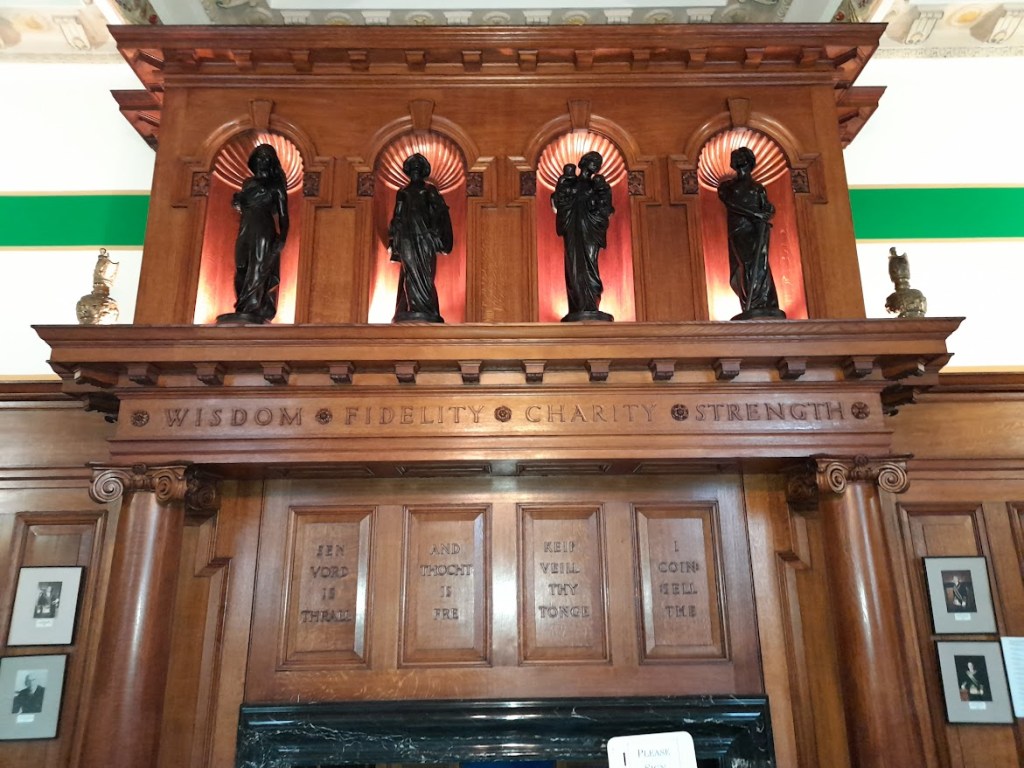
On entering the building the visitor is greeted with a magnificent Entrance Hallway with a wide-open fireplace created of antique marble surrounded by panelling. The panelling surrounding the Hallway, and which can be found throughout the building, is of Austrian Oak. There are four alcoves above the fireplace containing bronze figures representing ‘WISDOM’, ‘FIDELITY’, ‘CHARITY’, and ‘STRENGTH’.
Below these figures and in four panels over the fireplace are carved words in old Scots verse taken from the Abbot Pitcairns’ House in Dunfermline.
‘SEN VORD IS THRALL’ ‘AND THOCHT IS FRE’
‘KElP VEILL THY TONGE’ ‘I COINSELL THE’
Roughly translated they mean:
‘Since your word is given’ ‘Though your thought is free’
‘Keep close your tongue’ ‘I council you’.
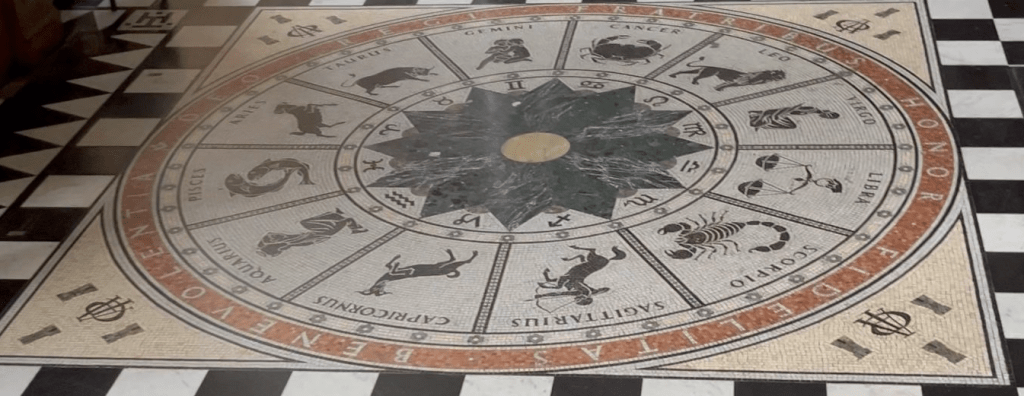
The floor of the Entrance Hallway is inlaid in mosaic pattern with black and white marble and a magnificent eleven-foot diameter circle, showing the twelve signs of the Zodiac, in the centre; while the ceiling is adorned with colourful fruit and flower ornamentation.
Portraits of the Provincial Grand Masters of the Aberdeen City Province, in ascending order from the left, can be seen here. The present day term of Office is five years.
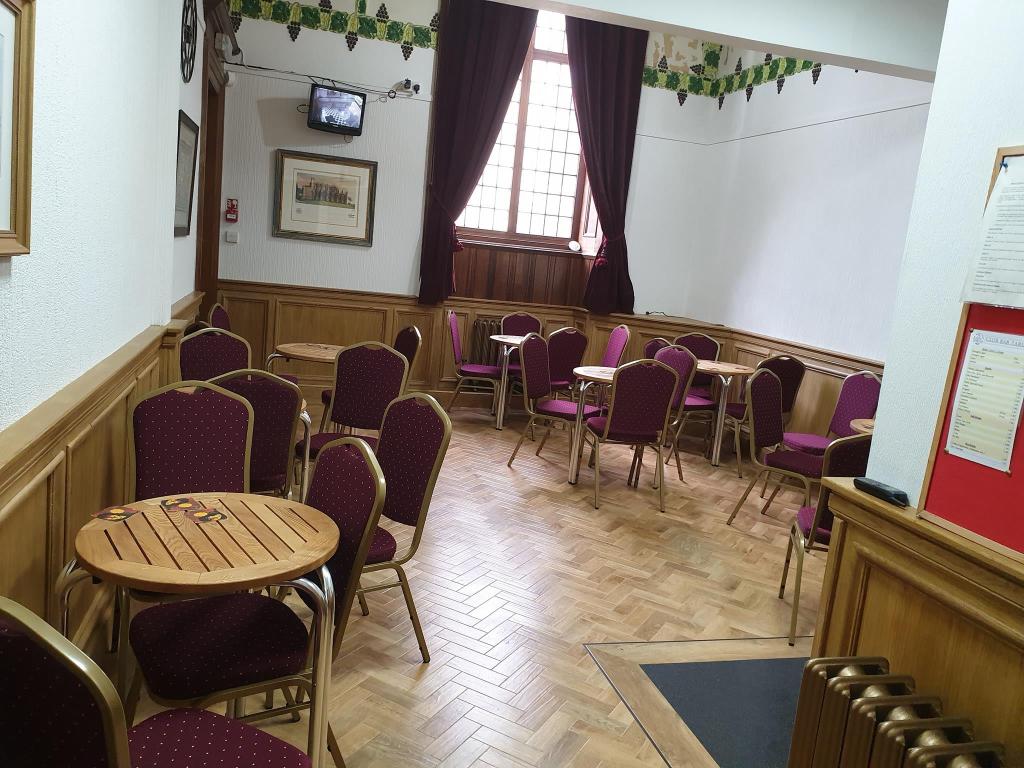
To the left of the Entrance Hallway a small lounge has been created out of two small Committee Rooms, for the purpose of Brethren having a social point of contact after attending meetings within the building. Its use is strictly controlled.
To the left of the fireplace is the entrance to The Provincial Hall, which is used by Provincial Grand Lodge and two other Lodges for their meetings.
A feature of this Hall is an octagonal cupola inset in the ceiling. On the frieze can be seen the seals of the Provincial Grand Lodge and the twelve Lodges which comprise the Province.
To the right of the fireplace is the entrance to the Chapter Room or Hall, with spacious anterooms, and features a colourful presentation with richly panelled walls and a superbly ornamented frieze and ceiling.
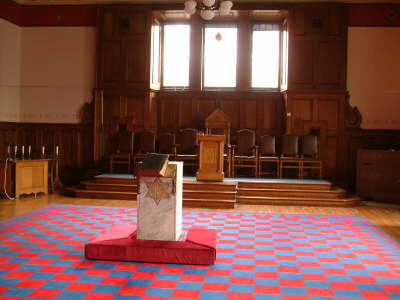
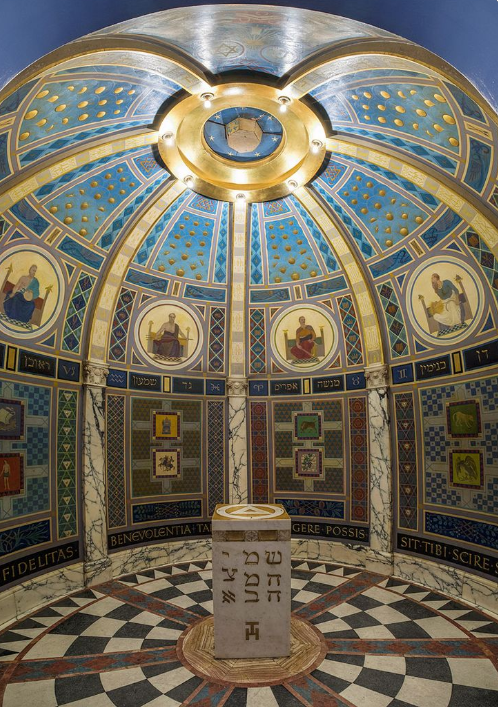
A special feature leading from one of the Chapter Hall anterooms is a winding stairway leading down to a magnificent ‘Vault’, which has been described as ‘The jewel in the crown of the building’.
This small chamber has reproductions of the highest quality, rich in detail, an astonishing sense of perspective creating an atmosphere of awe and wonderment.
Please note that because of the size and nature of the stairway, it cannot be opened to the public.
The lower half of the chamber has marble pillars, inlaid decoration, signs of the Zodiac and the names of the Hebrew Tribes and the upper part is richly painted.
The Chamber is in its original state and as beautiful today as when created.
To the right of the Entrance Hallway is a bust of Alexander Wilson and a Chair belonging to Lodge St George, No. 190, dating from 1736, which was used during the Consecration Ceremony in 1911.
A staircase of Austrian oak with carved newels leads from the Entrance Hall to the first floor where there is a spacious hallway the width of the building with display cases and double twelve-foot high doors leading to the Main Temple Hall.
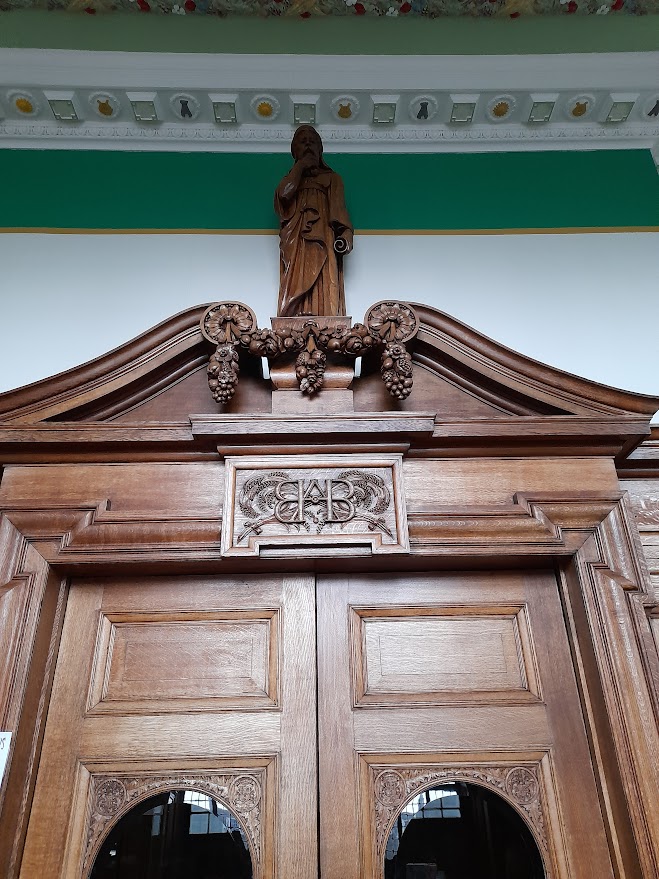
These doorways have glazed porthole apertures and a panel above them depicting a pediment of carved scroll and flower work supporting an almost life size figure of Hiram Abif, who by Masonic Tradition was the architect of King Solomon’s Temple.
His bowed head just avoids the richly decorated ceiling.
Through the doors is an entrance hallway with the walls lined with storage cupboards for the regalia and artefacts of the various Lodges and further anterooms.
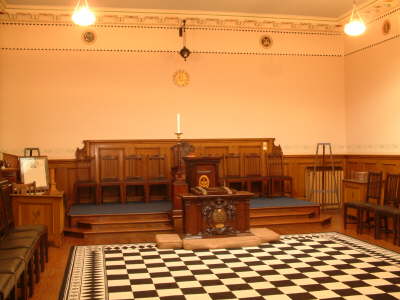
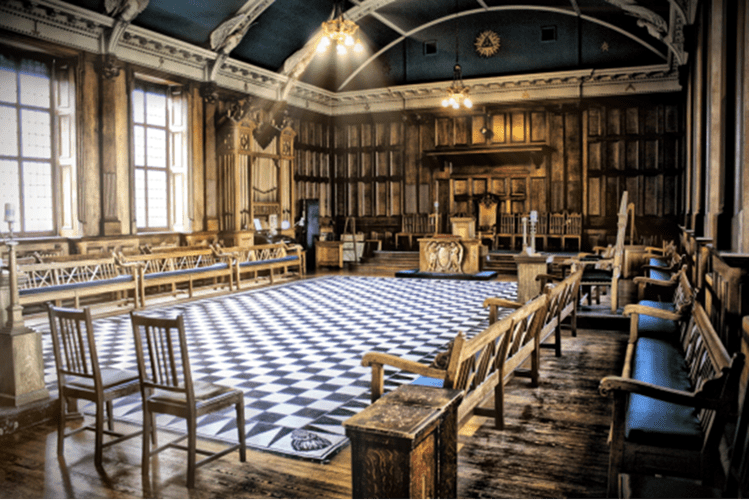
Large double doors lead into the main Temple, or Craft, Hall, which has a gently arched ceiling with heavy beams resting on a richly decorated cornice and as can be seen throughout the building signs of medieval Masonry set in a strong Renaissance atmosphere.
The building was opened for use in 1910 and Consecrated with full Masonic ceremonial on 7th January, 1911, and re-Consecrated in April 2011, again with full Masonic Ceremonial, and is the meeting place for nine of the ten Lodges in the Province of Aberdeen City, two Royal Arch Chapters and various other Appendant Masonic Orders. This can result in meetings taking place on all week-day evenings. It is not unusual for all three halls and various other rooms to be in use at the same time.
In 2021 Freemasons’ Hall Aberdeen was officially recognised as a Charity by OSCR and is available for use as venue by the general public in central Aberdeen.
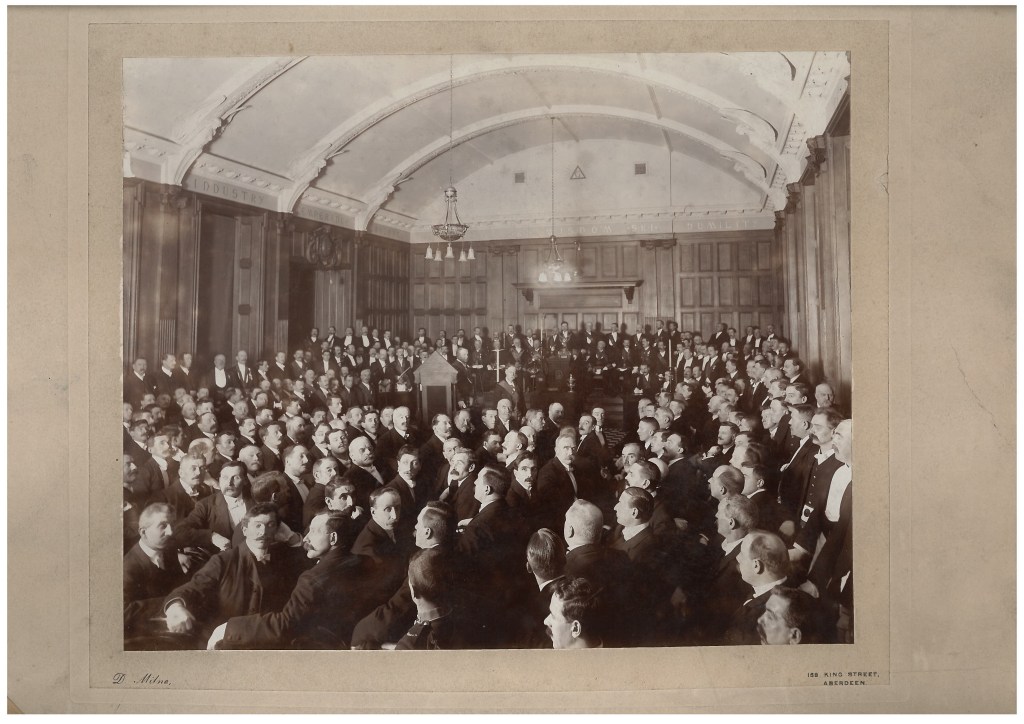
 Freemasons' Hall Aberdeen